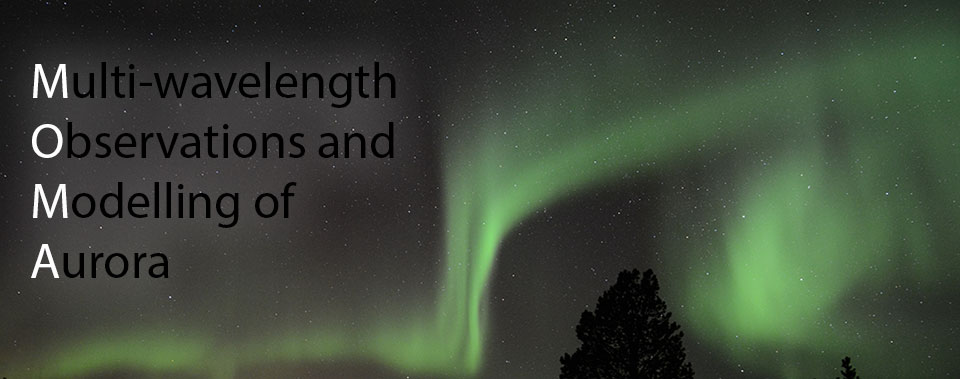
This is a research project funded by the Belgian Science Policy Office (BELSPO) under the BRAIN-be programme. It is devoted to an in depth investigation of auroral processes through experimental, theoretical and numerical research.
The mechanisms behind the formation of auroras in the polar regions of Earth have intrigued scientists for a long time. A large fraction of the energy flowing from the solar wind to the Earth is channelled through the Earth’s magnetosphere to the polar ionosphere, where it manifests itself in the phenomenon of the aurora or “polar lights”.
The auroral current circuit can be viewed as being composed of four elements:
- a generator in the equatorial magnetosphere,
- a load in the ionosphere that are coupled together by
- the regions of upward and downward current flowing along magnetic field lines.
Auroras have also been observed from all the magnetized planets in the solar system with different characteristics from Earth since their atmosphere and magnetosphere are different, but the fundamental plasma processes behind the formation of the aurora are universal. Therefore, studying aurora is a key to a better understanding of physical processes in a solar system and astrophysical context. It also allows us to obtain a better understanding of the near-Earth space, and this is for example important for our ability to protect ourselves against space weather hazards.